Riemann and artificial
In 1859, when the first electronic computers were still decades away, the German mathematician…
Search
In 1859, when the first electronic computers were still decades away, the German mathematician…
Thousands of cancelled flights, disruptions to banking services, inaccessible communication…

Imagine your banking app classifies a meal with friends as a business expense. Or an artificial…
In 1859, when the first electronic computers were still decades away, the German mathematician Bernhard Riemann published a paper of just eight pages that would change the history of mathematics. In it, he proposed a hypothesis about the distribution of prime numbers that would become one of humanity’s greatest intellectual challenges.
Since then, we have developed computers, sent humans to the Moon, deciphered the human genome and created artificial intelligence systems capable of generating code and solving complex problems. Yet the Riemann hypothesis has withstood the efforts of generations of mathematicians.
On 20 November 2026, Levent Alpöge, a mathematician and Anthropic researcher, announced that he had found a proof of the hypothesis with the help of Claude, Anthropic’s artificial intelligence system. The proof was presented through more than 17 million lines of code and has already passed several independent formal verifications, although the mathematical community’s examination of it continues.
From eight pages to 17 million lines of code. Between the two publications lie not only 167 years of history, but also a profound transformation in the tools with which human beings explore the limits of knowledge.
But what is so special about prime numbers? Why has this hypothesis fascinated so many generations? And what role might artificial intelligence play in the future of scientific discovery?
Prime numbers are one of the simplest concepts in mathematics and, at the same time, one of the most fascinating. They are natural numbers greater than one that can be divided exactly only by one and themselves: 2, 3, 5, 7, 11, 13, 17, 19…
Their importance lies in the fact that every integer greater than one can be expressed uniquely, apart from the order of the factors, as a product of prime numbers. That is why they are often regarded as the atoms of arithmetic: the fundamental building blocks from which all other numbers are made.
What is truly surprising is their distribution. We find prime numbers very close to one another, such as 11 and 13, but also arbitrarily long intervals in which none appear.
We have known since the time of Euclid, more than two thousand years ago, that there are infinitely many prime numbers. We also know that, as we move towards larger numbers, they become less and less frequent on average.
However, their distribution does not follow a simple periodic pattern. At a small scale it appears irregular, whereas at a large scale remarkably precise statistical regularities emerge.
A particularly interesting way of visualising this combination of irregularity and structure is the Ulam spiral, discovered in 1963, in which natural numbers are arranged in a spiral and only prime numbers are highlighted.
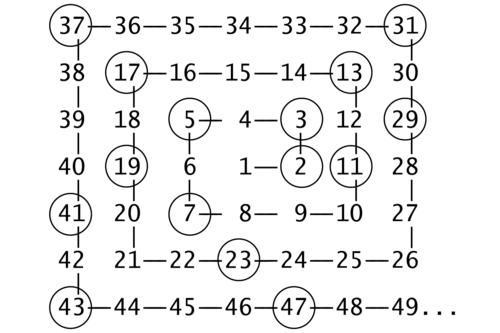
This coexistence of order and apparent randomness is what has fascinated generations of mathematicians. To what extent can we understand and describe that order?
In 1859, Bernhard Riemann proposed a completely different way of approaching this question: looking beyond the prime numbers themselves.
In 1859, Bernhard Riemann published a work entitled On the Number of Prime Numbers Less Than a Given Magnitude. His contribution was to approach the problem of the distribution of prime numbers from a different perspective, using tools from complex analysis.
To do so, he turned to a mathematical function that Leonhard Euler had already studied in the eighteenth century and which we now know as the Riemann zeta function.
Riemann extended the study of this function into the realm of complex numbers and established a profound connection between its zeros — the values for which the function equals zero — and the distribution of prime numbers.
He observed that certain zeros, known as non-trivial zeros, appeared to lie on the same vertical line in the complex plane, whose real part is equal to 1/2.
His hypothesis held that all these zeros, without exception, lie on that line, known as the critical line.
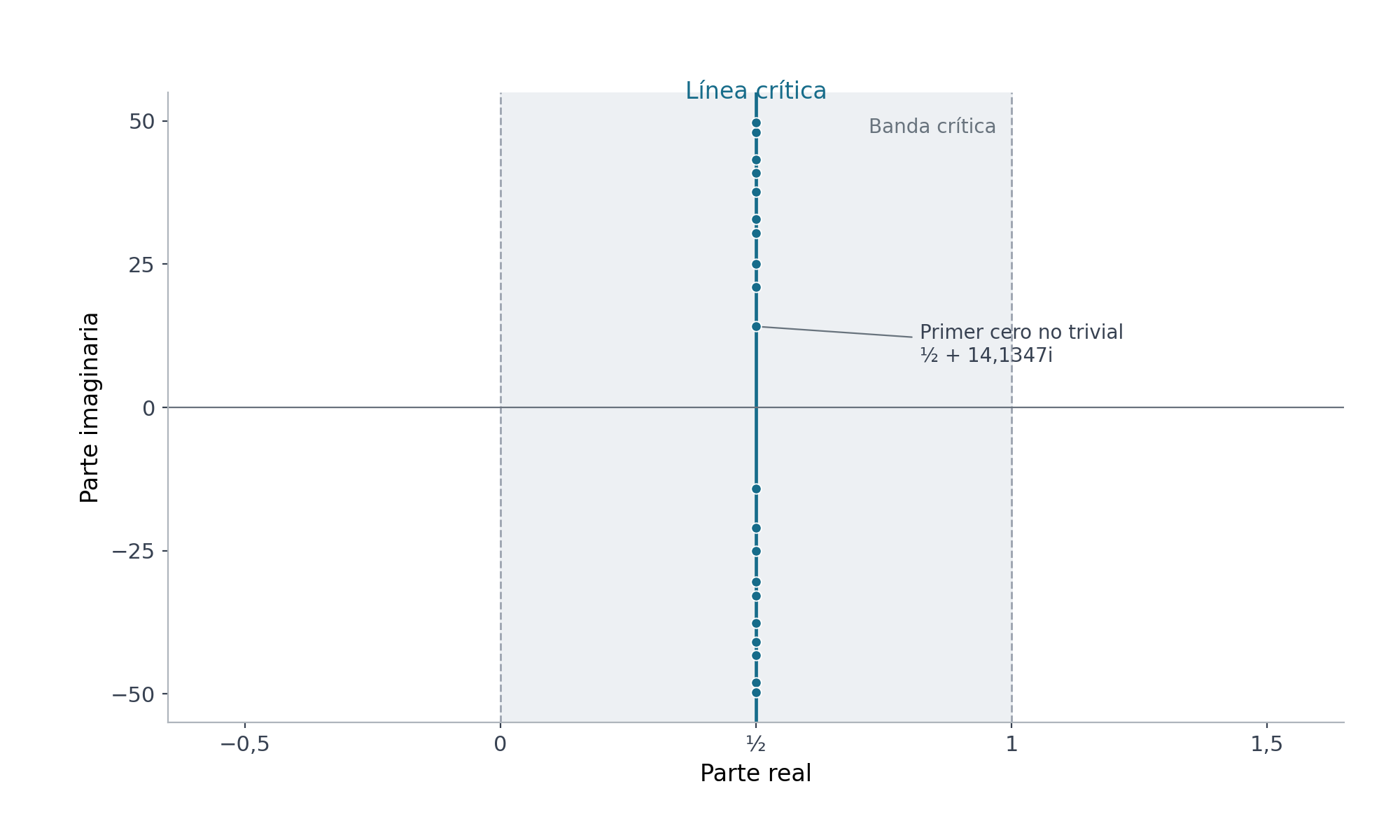
Why is this observation so important? Because the location of these zeros is related to the deviations between the actual number of prime numbers below a given value and the mathematical estimates of that number.
If the hypothesis is true, those deviations would be subject to much more precise bounds.
Riemann’s genius lay in connecting two seemingly distant mathematical worlds: that of natural numbers and that of functions of a complex variable. It was a connection that opened up new possibilities for understanding one of the most fundamental structures in mathematics.
The importance of the Riemann hypothesis extends far beyond a better understanding of the distribution of prime numbers. Its proof would make it possible to establish many mathematical results which, until now, depend on the hypothesis being true.
In number theory, it would provide greater precision to estimates concerning the distribution of primes and strengthen our understanding of the relationships between different mathematical structures.
In computer science, its implications are chiefly related to the analysis of algorithms. Some results concerning their efficiency and mathematical guarantees depend on the Riemann hypothesis or on broader versions of it, such as the generalised Riemann hypothesis.
Cryptography is another particularly interesting area. Prime numbers play a fundamental role in cryptographic systems such as RSA, used to protect information and verify digital signatures. Their security is based on the computational difficulty of factoring very large integers.
However, proving the Riemann hypothesis does not mean automatically finding an efficient way to factor these numbers or compromising the security of current cryptographic systems.
Its true impact lies in expanding our mathematical knowledge and providing stronger foundations on which to develop and analyse new computational tools.
The history of computer science reminds us that mathematical discoveries initially regarded as abstract can end up becoming essential components of our technological infrastructure. Public-key cryptography itself is a good example of this.
Since Riemann formulated his hypothesis, generations of mathematicians have devoted part of their research to attempting to prove it. Although no complete proof was achieved for decades, that search has led to significant scientific advances.
In 1914, the British mathematician Godfrey Harold Hardy proved that infinitely many zeros of the zeta function lie on the critical line. An important result, though an insufficient one: proving that infinitely many zeros satisfy the hypothesis does not mean proving that all of them do.
The emergence of computers opened a new chapter in this research. What had previously required laborious manual calculations could be carried out on a scale that had until then been unimaginable.
In 2021, mathematicians David Platt and Timothy Trudgian published a rigorous numerical verification confirming that all non-trivial zeros with positive imaginary part below three trillion lay on the critical line.
However, here we encounter a fundamental difference between numerical verification and mathematical proof.
However many cases we manage to verify, there is always the possibility that an exception may appear beyond the limits of our calculations. A mathematical proof must establish that a statement is true in every possible case, not only in those we have been able to check.
In 2000, the Clay Mathematics Institute included the Riemann hypothesis among the seven Millennium Problems, offering a prize of one million dollars for its resolution.
In this context, the arrival of artificial intelligence introduces a new possibility: using machines not only to perform calculations and verify results, but also to explore lines of reasoning and develop mathematical proofs.
On 20 November 2026, Levent Alpöge, a mathematician and Anthropic researcher, published a brief document on his website in which he announced that, working with Claude, he had found a proof of the Riemann hypothesis.
The result went even further: it included a proof of the generalised Riemann hypothesis for Dirichlet L-functions, an extension of the original problem.
However, what was extraordinary was not only the result, but also the way it was presented. Instead of a conventional mathematical paper, Alpöge published approximately 17 million lines of code distributed across more than 175,000 files written in Lean.
Lean is a programming language and mathematical proof assistant that makes it possible to express definitions, theorems and reasoning in a formal language. Its verification system checks that proofs comply with established logical rules and mathematical foundations.
This combination of technologies is particularly interesting. While Claude can explore strategies and generate mathematical reasoning, Lean can formally verify its validity. The correctness of a proof therefore does not depend on the trust we place in artificial intelligence’s responses.
On 21 November, the Lean and Mathlib community announced that the proof had passed independent verifications. It also confirmed that the proposition proved corresponded to the definition of the Riemann hypothesis already present in its mathematical library.
As of 25 November 2026, the mathematical community continues to analyse the result, and the Clay Mathematics Institute has not yet officially recognised the resolution of the problem.
Nevertheless, we are looking at a scientific event that reveals a new way of conducting research, in which human mathematical knowledge, artificial intelligence and formal verification systems can work together.
And this collaboration raises an extraordinarily interesting question: what happens when we are able to verify a mathematical proof whose complexity makes it immensely difficult to understand?
Finding a solution, verifying that it is correct and understanding why it works are three different tasks. The proof of the Riemann hypothesis announced this week highlights this distinction.
A formal proof makes it possible to check that every step of the reasoning is valid and that the conclusion follows logically from the premises. However, this does not necessarily mean that we can identify the fundamental ideas that made it possible to reach the result.
In software engineering, we encounter a similar situation. A program may pass every planned test and meet its specifications without its developers fully understanding its internal workings. Even when we use formal verification techniques, proving that a system satisfies certain properties is not equivalent to understanding every decision underpinning its architecture.
This distinction becomes particularly relevant with the incorporation of artificial intelligence into software development. Generating code is becoming ever easier, but interpreting, maintaining and evolving that code still require knowledge and analytical ability.
In mathematics, understanding a proof also has scientific value in its own right. Identifying the ideas that underpin it makes it possible to establish new connections, develop methods and tackle other problems that had until then seemed inaccessible.
The next challenge lies not only in verifying those millions of lines of code, but also in extracting from them mathematical knowledge that can be understood, shared and used by future generations of researchers.
Collaboration between mathematicians, artificial intelligence systems and formal proof assistants opens a particularly promising landscape for scientific research.
Imagine being able to explore thousands of strategies simultaneously to solve a problem, identify connections between seemingly distant disciplines, or recover lines of research abandoned through lack of resources or computational capacity.
The potential of this collaboration is not limited to mathematics. In fields such as physics, biology, chemistry and materials science, artificial intelligence can contribute to formulating hypotheses, designing experiments and exploring possibilities that would be difficult to address through traditional methods.
Each discipline, naturally, has its own validation mechanisms. While in mathematics we can turn to formal proof, in experimental sciences it remains essential to test results against reality.
New forms of collaboration could also emerge between researchers from different disciplines, facilitated by tools capable of working with different scientific languages, methodologies and representations of knowledge.
We are faced with the possibility of transforming not only the speed at which scientific discoveries are made, but also the nature of the questions we dare to ask.
Problems that until now seemed too complex, costly or ambitious could become new research opportunities. And perhaps some of the most interesting discoveries of the future will arise precisely from questions we have not yet asked.
Bernhard Riemann could hardly have imagined that, 167 years after publishing his work, an artificial intelligence would take part in the search for a proof of his hypothesis.
But perhaps the most fascinating aspect of this story is a question’s ability to transcend generations, survive major technological transformations and inspire new forms of knowledge.
The search for a proof of the Riemann hypothesis has driven the development of mathematical methods, computational tools and lines of research whose value extends far beyond the original problem.
Artificial intelligence is now joining this long tradition of scientific exploration, expanding our possibilities and offering us new tools for approaching the unknown.
Yet at the origin of this entire journey remains something profoundly human: curiosity.
In an increasingly technological world focused on immediacy, productivity and obtaining results, Riemann’s story reminds us that some of the most valuable questions are those whose answers may take generations to arrive.
Now that we have tools that expand our ability to find answers, what new questions will we dare to ask?

We increasingly make decisions with the help of an automatic recommendation.A platform chooses which video we will watch next. An app suggests how to reply to…

Many organisations have dashboards full of figures on visits, clicks, conversions, time spent or satisfaction. However, having more data does not mean…

Sometimes, the problem does not begin when traffic falls. It begins when there is too much of it.That is what happened when reviewing the data from a client’s…

There comes a point in many organisations when the conversation about marketing moves to another room. It is no longer confined to the communications team, the…








Comments